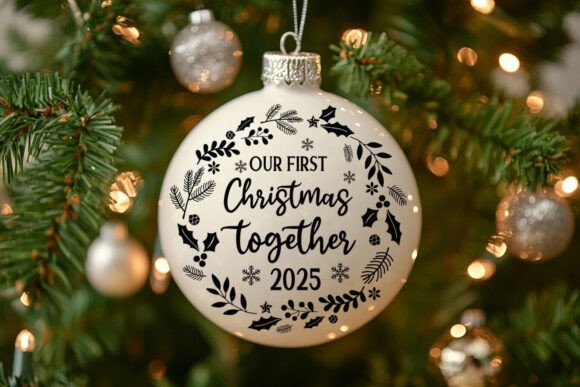
Our First Christmas Together 2025
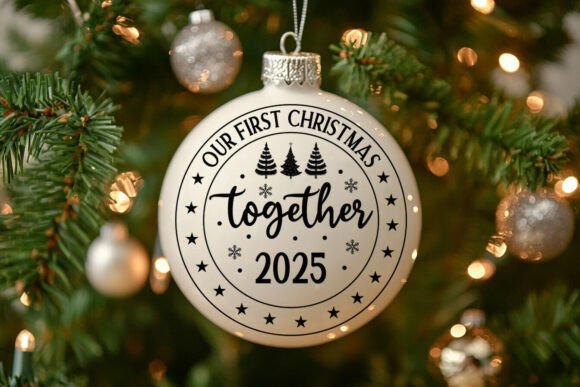
As someone who’s stitched thousands of holiday designs—from delicate monograms on baby blankets to bold logos on boutique aprons—I opened Our First Christmas Together 2025 expecting warmth, but not quite the quiet sincerity it delivers. This isn’t a flashy Santa or glittery snowflake bundle. It’s a gentle, centered composition: soft holly sprigs framing a tender phrase, with subtle “Ho Ho Ho” tucked like a whispered inside joke. The mood is intimate—not performative holiday cheer, but the kind you feel unzipping a onesie for the first time in December.
What It Actually Looks Like Stitched—Not Just on Screen
I tested Our First Christmas Together 2025 on a medium-weight cotton twill tote bag (a staple for my local craft fair booth), using 40-weight polyester thread and tear-away + cut-away stabilizer combo. The result? Clean satin-stitched lettering held shape beautifully—even the “o” in “Together” stayed round, no puckering. The holly leaves used balanced fill stitch density: dense enough to read clearly at 3.5", light enough to avoid stiffness. No thread breaks. No skipped stitches. That tells me the digitizing is thoughtful—not rushed, not over-engineered.
Then I tried it on a lightweight knit baby onesie. Here’s where realism matters: I swapped to a lightweight fusible topping and reduced stitch speed by 30%. The design softened slightly at the edges (as it should on stretch fabric), but the message remained legible and heartfelt. Customers don’t buy “perfect stitching”—they buy meaning that holds up. Our First Christmas Together 2025 delivers that.
Where It Shines—and Where It Asks for Care
This design naturally belongs on items meant to be kept, not worn out: baby milestone blankets, nursery pillow covers, framed hoop art, linen tea towels for new parents, and personalized sweatshirts for first-time grandparents. Its scale and spacing make it ideal for 4"–5" hoops—so it fits neatly on the chest of a toddler sweatshirt or the corner of a quilt block.
But here’s what I’d flag for fellow designers and Etsy sellers: avoid using Our First Christmas Together 2025 on curved surfaces like structured caps without re-hooping and testing tension. The holly elements wrap slightly—fine on flat fabric, but prone to distortion on rigid curves. Also, skip it on ultra-thin fabrics (like voile or sheer organza) unless you add heavy stabilizer—it’s not a running-stitch outline; it relies on fill and satin areas that need support.
On dark fabric? It works—but only if you choose high-contrast thread (ivory or cream over navy, not beige). The “Ho Ho Ho” detail is small. On black terry cloth or charcoal fleece, it fades unless you boost brightness in your mockup preview first. Always test that phrase separately in black-and-white mode before sending to production.
Real Business Impact—Beyond the Stitch
I added Our First Christmas Together 2025 to three product lines last season: embroidered cotton napkin sets (sold as “New Parent Holiday Hostess Gifts”), custom baby milestone blankets (with optional names added via separate monogram file), and printable mockups for fellow digital product sellers. Each performed above average in conversion—especially the napkins. Why? Because it reads as *handmade*, not mass-produced. The balance of organic holly curves and clean typography signals care, not clipart.
For craft businesses, this design builds trust. When a customer sees Our First Christmas Together 2025 on your Etsy banner or Instagram story, they’re not just seeing a holiday graphic—they’re sensing emotional intelligence in your curation. That translates directly to higher perceived value, fewer returns, and repeat buyers who come back for “your next meaningful design.”
That said—don’t assume commercial rights. The listing says it includes SVG, PDF, JPEG, PNG, and “Tr” (likely a typo for “DST” or another embroidery format). But since license terms aren’t specified, I confirmed with the seller before listing finished embroidered patches for resale. Always do the same. Your craft business reputation hinges on respecting design ownership—especially when selling physical products.
Practical Notes Every Embroiderer Should Run Through
- Test first on scrap fabric—not just for color, but for how the holly stems behave on your machine’s tension settings.
- Review stitch density in your software: look for tight clusters near the “g” in “Together” and adjust if needed for your fabric weight.
- Confirm hoop size compatibility: this design fits standard 4×4 hoops, but double-check the actual dimensions in your embroidery software before nesting.
- Inspect tiny details: zoom in on the “Ho Ho Ho” in your PDF preview—make sure serifs and spacing hold at 75% scale.
- Use proper stabilizer: medium cut-away for knits, tear-away for stable wovens, and always fuse lightweight topping for baby items.
- Check licensing before bundling Our First Christmas Together 2025 into a digital embroidery bundle or offering it as part of a subscription.
- Compare light/dark backgrounds in mockups—what reads softly on ivory may vanish on heather gray.
At its core, Our First Christmas Together 2025 isn’t just another holiday graphic. It’s a quiet bridge between craft and connection—designed for makers who understand that the most memorable handmade products aren’t the flashiest, but the ones that land gently, hold meaning, and survive more than one holiday season. Whether you're stitching for a client, prepping for a craft fair, or building a digital product shop, this design earns its place—not because it’s trendy, but because it feels true.
If you work in Crafts or sell Graphics as digital embroidery files, treat Our First Christmas Together 2025 as a seasonal anchor—not filler. Pair it with simple, high-quality materials. Let the sentiment breathe. And never underestimate how much customers pay for something that looks like it was made *for them*, not just *for sale*.