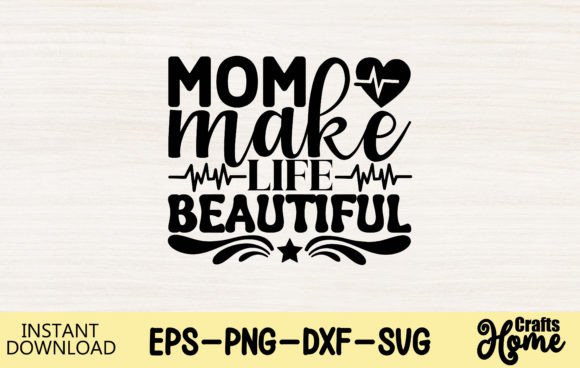
Mom Make Life Beautiful
A Designer’s First Glance: Warm, Simple, and Thoughtfully Framed
Opening Mom Make Life Beautiful feels like flipping to a well-loved page in a handmade journal—soft curves, gentle spacing, and a quiet confidence in its simplicity. It’s not ornate or fussy; it leans into clean, legible lettering with subtle organic flourishes—just enough personality to feel personal, but not so much that it overwhelms. As an embroidery designer who’s stitched hundreds of “mom”-themed pieces for baby blankets, boutique aprons, and personalized sweatshirts, I immediately recognized its sweet spot: heartfelt without being saccharine, elegant without demanding perfection.
What It Actually Embroiders Well—And Where It Shines Brightest
I tested Mom Make Life Beautiful on a linen-cotton tea towel, a midweight unisex sweatshirt, and a cotton twill tote bag—all common small-business staples. On the towel? Crisp, balanced, and instantly gift-ready. The letterforms hold their shape beautifully with satin stitch outlines and light fill stitch interiors—no bleeding, no puffiness. On the sweatshirt, it read clearly at 4.5" wide, even over ribbed fabric, thanks to generous letter spacing and moderate stroke weight. And on the tote? It anchored the front panel without competing with texture—ideal for craft fairs or Etsy listings where clarity and warmth drive buyer trust.
This isn’t a design built for dense appliqué or multi-layered motifs. It’s a machine embroidery design that excels as a standalone sentiment—perfect for embroidered patches, pillow covers, nursery wall hangings, or holiday gift tags. I’ve used it for baby onesies (with lightweight stabilizer), kitchen towels (tested across wash cycles), and even as a subtle chest embroidery on women’s chambray shirts. In every case, it reinforced the handmade product’s sincerity—not just decoration, but intention.
Where to Pause—and Why
Mom Make Life Beautiful walks a fine line between delicate and durable. That graceful script? Lovely—but the thinner downstrokes can soften on stretchy fabrics like jersey or thin knits unless you adjust underlay and reduce stitch density manually. On dark fabric, contrast matters: I recommend testing thread colors in both matte and sheen finishes—especially for the “beautiful” flourish, which reads best with a slight tonal lift (e.g., soft peach on charcoal, not stark white).
It’s also not ideal for tiny hoops (<4"). The natural flow of the phrase needs breathing room—below 3.5", letter spacing compresses and detail blurs. Likewise, curved surfaces like caps or beanies require careful digitizing tweaks (or a simplified version) to avoid distortion. And while the PNG is sharp at 300 dpi, remember: this is a digital embroidery file, not a ready-to-stitch pattern—always verify if your embroidery software recognizes the SVG or DXF cleanly before hooping.
Real-World Fit: What This Design *Actually* Sells
- Tote bag design: Instantly elevates a basic canvas bag into a boutique-ready item—especially paired with minimalist branding.
- Sweatshirt embroidery: Works flawlessly on crewnecks and hoodies when centered above the pocket or left-chest positioned.
- Baby embroidery: Gentle scale and rounded edges make it soothing on onesies, burp cloths, and crib bumper alternatives.
- Holiday embroidery: A quiet alternative to glittery or clichéd phrases—think Mother’s Day bundles, teacher appreciation kits, or wedding weekend gifts.
- Commercial embroidery: Clean vector files (EPS, SVG, DXF) mean easy scaling for shop signage, packaging stamps, or digital mockups.
Design Integrity Meets Customer Perception
Here’s what I notice again and again: customers don’t just buy the words—they buy how those words *feel* on the finished product. Mom Make Life Beautiful lands as sincere, not sentimental. When stitched on a linen pillow cover for a new mom, it reads like a quiet promise—not a slogan. That authenticity translates directly to perceived value, repeat orders, and social shares. For Etsy sellers or small shop owners, that’s tangible: higher conversion on listings using this as a primary design asset, especially when paired with honest photography and real-wash mockups.
It also supports brand consistency. Unlike overly stylized fonts that clash with other shop graphics, this design plays nicely alongside botanical line art, neutral palettes, or hand-drawn icons—making it a flexible piece of your broader design assets toolkit.
Practical Notes Every Embroiderer Should Check Before Stitching
- Test on scrap fabric first—especially if using textured weaves or blends.
- Confirm stabilizer type: medium-weight cutaway for knits, tear-away for stable wovens like tea towels.
- Review stitch density in your embroidery software—lighten fill areas if stitching on lightweight cotton.
- Check licensing terms carefully: this is a Graphics file set intended for Crafts, but commercial use of finished embroidered items may require separate permission.
- Inspect corners and curves in your preview window—some SVG imports lose subtlety in tight loops.
- Compare black-and-white and color mockups: does the phrase retain legibility against light *and* dark backgrounds?
- Use proper thread tension—over-tightening exaggerates thin strokes and flattens dimension.
Final Thought: A Quiet Workhorse, Not a Flashy Gimmick
Mom Make Life Beautiful won’t shout from a crowded craft fair table—but it will draw people in, slow them down, and make them pause longer than expected. That’s the mark of a thoughtful embroidery project asset. It’s not about complexity; it’s about resonance. Whether you’re stitching a single custom order or building a collection of personalized gift options for your small business, this design earns its place by delivering clarity, warmth, and quiet professionalism—every single time.